
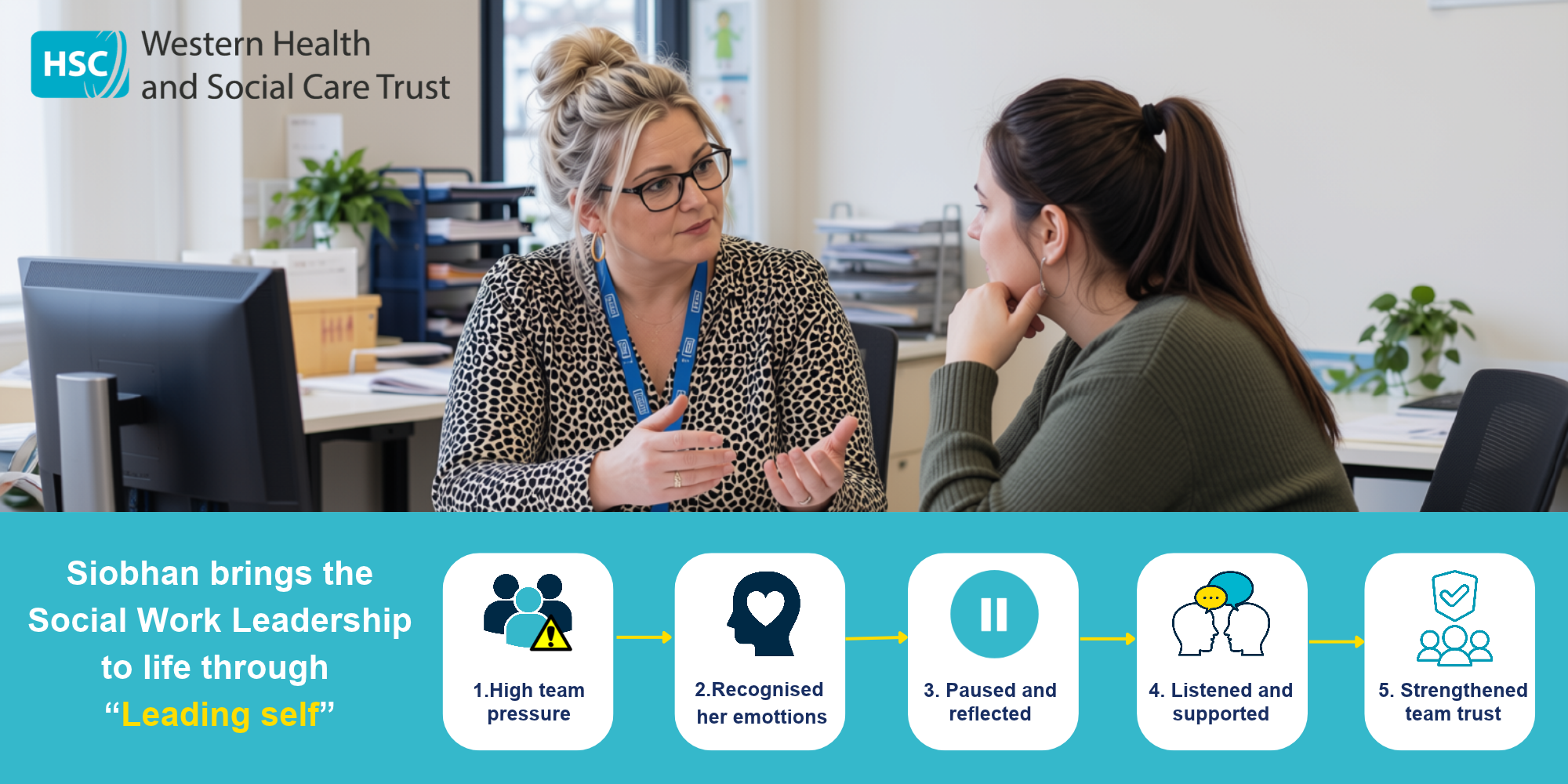
Source: This is an AI-generated image created with Microsoft Copilot. No external photograph, stock image, or third-party visual source was used.
Case summary
Siobhan is a Social Work Manager in a Family and Child Care Team in the Western Health and Social Care Trust (WHSCT) and manages seven social work staff. Part of her role is supporting her team. This case study is an example of a particular week, when three of her team members were on leave, leaving limited capacity to visit families and respond to urgent requests. The pressure to manage workloads and meet statutory timescales was high and Siobhan shows how social work leadership is necessary in such circumstances.
_____________________________________________________________________________________________________________________________________
Applying the Leadership Framework – Leading self
In the middle of this challenging day, one of the newly qualified social workers, approached Siobhan visibly upset about an issue with a case. At first glance, the matter did not seem urgent compared to the immediate priorities Siobhan was juggling. Feeling overwhelmed and slightly irritated, she was tempted to ask the staff member to return later so she could focus on managing the more urgent tasks.
Before responding, Siobhan paused and reflected on the ‘Leading Self’ domain of the Social Work Leadership Framework, particularly the capabilities of self-awareness, emotional intelligence and authenticity. She believed that role-modelling positive behaviours under pressure was important. She recognised her irritation was influenced by stress and that delaying the conversation would leave the staff member with feelings of distress and could also damage trust and team morale.
Instead of dismissing the concern, Siobhan chose a different approach. She took a few deep breaths, regulated her emotions, and invited the staff member to have a brief conversation, agreeing a clear time boundary. She listened actively, acknowledged the staff members feelings and affirmed some of the actions suggested by the newly qualified social worker. She agreed to revisit the issue in more depth later that day, once immediate priorities were stabilised. This showed empathy while maintaining boundaries and focus on urgent tasks.
_____________________________________________________________________________________________________________________________________
Takeaway – It helps you understand leadership and recognise how you are a leader
Siobhan shows that the time invested in recognising her own emotions, being aware of her staff member’s feelings, and providing the necessary check in was in itself timesaving, but does not always come so easily in a busy environment. What had helped was to have the four leadership domains printed and displayed on the wall as a visual reminder.
_____________________________________________________________________________________________________________________________________
Outcome
By applying the domain of ‘Leading Self’, Siobhan transformed a potentially negative interaction into a supportive one. The newly qualified social worker felt heard and valued, reducing her distress, and Siobhan modelled calm, reflective leadership in a time of pressure and stress, strengthening team trust and resilience.
Reflecting on how she had changed her approach, she felt satisfied with her response and that it had made a positive difference, not only in the support the staff member experienced, but also in developing her resilience and how this linked with the ‘Leading with Others’ domain.
When they spoke again, the staff member said that Siobhan’s approach helped them to calm and regulate their feelings. She realised that they had overreacted because they picked up on the overall stress within the team. The situation made her think about how important it is to be self-aware and notice those feelings early and use self-care strategies to stay grounded in difficult moments.