
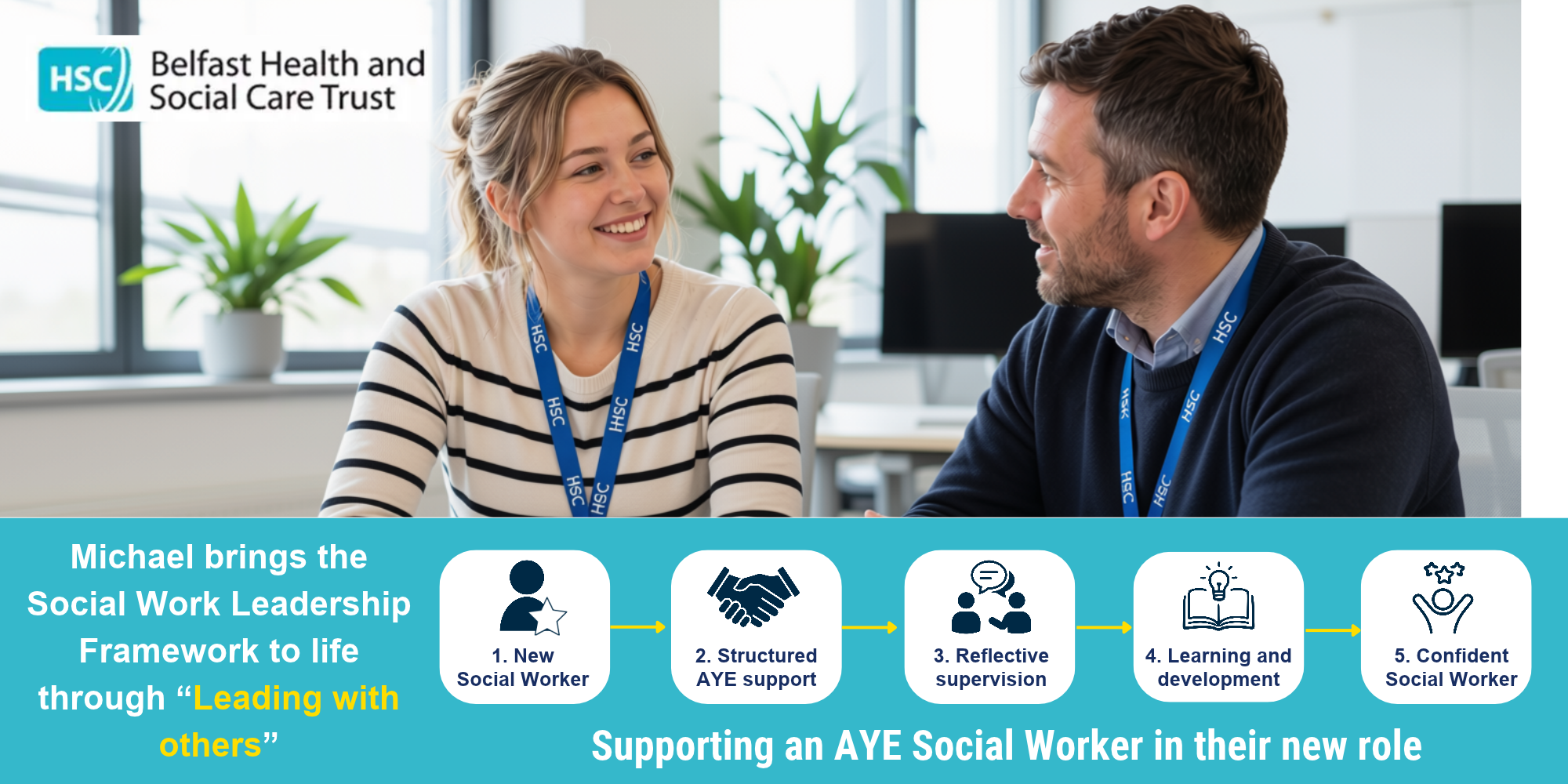
Source: This is an AI-generated image created with Microsoft Copilot. No external photograph, stock image, or third-party visual source was used.
Case summary
Jane is a social worker in her Assessed Year of Employment (AYE) and works in children’s residential services for the Belfast Health and Social Care Trust. She has never worked in residential services before and she felt anxious about how she would settle into the team and it felt like she would require a lot of training and support in her new role. Michael is a team member who is a qualified social worker and has worked in the residential home for the past two years. He was asked by the manager to ‘buddy’ Jane throughout her AYE year and has been reflecting on this experience and what it means for him as a social work leader.
_____________________________________________________________________________________________________________________________________
Applying the Leadership Framework – Leading with others
Michael demonstrated ‘Leading with Others’ in a number of ways:
- Supporting new team member to integrate: He ensured Jane was introduced to colleagues and young people in a supportive and inclusive manner. He did this by leading by example, i.e. demonstrated good practice through reflection (e.g. using crisis management techniques) and encouraged Jane’s originality and creative thinking. He talked through new ideas and strategic frameworks with her using case examples and application to practice. He also supported team members to be inclusive and complete an efficient induction with Jane. He updated senior staff about Jane’s progress and remained strengths-focused. Michael demonstrated good communication skills, addressed issues, encouraged active participation and promoted Jane’s sense of professional identity.
- Training support: Michael linked Jane into the Learning and Development Team with a specific point of contact. He helped her talk through options, encourage the sharing of knowledge with her and other team members, and supported Jane to share her learning with colleagues. He encouraged to have difficult conversations, plan well for supervision, support reflection on action, and develop resilience strategies. He also encouraged other team members to mentor/lead and ensure Jane was aware of her annual leave entitlements, supported by understanding of importance of work life balance. He did his across the team, encouraging others to lead by example. He further supported Jane by ensuring her attendance at AYE events, group supervisions, reflective practice and to be aware of therapeutic inputs for staff members.
- Networking and professional identity: Michael brought the relevant theories and methods of intervention to life by demonstrating their application in practice including the Framework for Integrated Care and Therapeutic (FITC) and Signs of Safety (SOS). He ensured Jane had early access to communication systems such as PARIS, Encompass, emails and telephone, enabling her to integrate quickly into the team. He also supported the development of her communication and presentation skills, building her confidence to contribute effectively within multi-disciplinary meetings. In addition, he explained the roles and responsibilities of colleagues helping jane to understand their respective functions and contributions to collaborative practice.
_____________________________________________________________________________________________________________________________________
Takeaway – It helps you understand leadership and recognise how you are a leader
Through collaborative work with Jane, Michael shows how important it is to build positive relationships, effective communication, working in partnership and valuing diversity in teams and communities. This shows he recognises the leadership role he has within his team, as a group and with senior leaders.
Michael understood the importance of empowering Jane to take an active role in her own development while also encouraging her to seek and accept support from others. He achieved this through regular encouragement, constructive feedback and by sign-posting relevant learning and development opportunities that enabled her to enhance her knowledge skills and confidence in practice.
_____________________________________________________________________________________________________________________________________
Outcomes
At an individual level Jane has developed a greater sense of purpose and a clearer understanding of her of role and role and the expectations associated with it. She has become more fully integrated within the team, demonstrating increased resilience, and a stronger sense of psychological safety, with the confidence to acknowledge and learn from mistakes. As a result, she has experienced increased job satisfaction, enhanced confidence and competence in her practice, developed reciprocal and supportive working relationships and established a stronger sense of her own professional identity within the team.
Across the team Michael’s support has contributed to greater stability by reducing staff turnover and strengthening team cohesion. This continuity has enabled team members to develop and retain specialist knowledge, fostered leadership from within the team and supported purposeful succession planning. The team have also benefitted from shared achieved learning drawing not only on Michael’s experience as a mentor but also the fresh perspectives that Jane brought as a social worker in her Assessed Year in Employment.
This work has also had a wider organisational impact across the Belfast Trust. Through Michael’s support Jane has continued to develop into a confident, competent social worker who represents the organisation professionally in her practice and interactions with colleagues, service users and partner agencies. The mentoring process has also increased awareness of the AYE role with others. More broadly. Michael’s commitment to supporting early career social workers contributes to strengthening recruitment and retention within specialist services while enabling practitioners to develop longer term professional growth.